
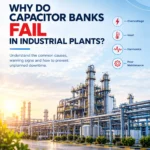
Why Do Capacitor Banks Fail in Industrial Plants?
Capacitor banks play an important role in industrial electrical systems. They help improve power factor, manage reactive power and improve the utilisation of electrical infrastructure.
Yet repeated capacitor failures are common in plants where electrical loads, operating conditions and system behaviour are constantly changing.
So why does a capacitor bank fail?
The answer is not always the capacitor itself.
Clariant Power looks at capacitor bank performance as part of the larger electrical system. Harmonics, resonance, changing loads, incorrect sizing and operating conditions can all influence how a capacitor bank performs over time.
Understanding these factors is essential when designing a reliable power factor correction system.
What Causes Capacitor Bank Failure?
1. Harmonic Distortion
Modern industrial facilities use equipment such as variable frequency drives, UPS systems, CNC machines and other power electronic loads.
These non linear loads can introduce harmonics into the electrical system. Since capacitor impedance decreases as frequency increases, harmonic currents can place additional electrical and thermal stress on capacitor banks.
If harmonic levels are significant, simply adding more capacitance may not solve the problem.
The electrical system needs to be assessed before deciding on the appropriate compensation and harmonic mitigation approach.
2. Resonance
Capacitor banks can interact with the inductance present in an industrial electrical network.
Under certain conditions, this can create resonance and amplify harmonic currents or voltages.
The result can include capacitor overheating, repeated fuse operation and premature failure.
This is why harmonic behaviour needs to be considered when designing capacitor banks for facilities with significant non linear loads.
3. Incorrect Sizing
A capacitor bank needs to match the actual reactive power requirements of the plant.
An undersized bank may not deliver the required power factor improvement.
An oversized bank can result in over compensation, particularly when plant loads are low.
Industrial facilities rarely operate at one constant load. Production schedules change, motors start and stop and different sections of the plant operate at different times.
The compensation system therefore needs to reflect the facility’s actual load profile.
4. Rapidly Changing Loads
Some industrial applications experience significant changes in reactive power demand within a short period.
In such applications, conventional switching may not respond quickly enough to changing conditions.
Frequent switching can also increase stress on capacitor stages and switching components.
For plants with fluctuating loads, real time compensation can be considered. Clariant Power’s RTPFC systems use thyristor switching for real time power factor correction in applications with rapidly changing loads.
5. Temperature and Operating Conditions
Capacitor banks also have to operate within suitable environmental conditions.
High ambient temperatures, inadequate ventilation and prolonged thermal stress can affect capacitor life.
This makes panel design, cooling, component selection and installation conditions important parts of capacitor bank reliability.
How Can Capacitor Bank Failures Be Prevented?
Replacing a failed capacitor may solve the immediate problem, but repeated failures require a closer look at the electrical system.
A proper assessment should consider:
- Power factor and reactive power demand
- Harmonic distortion
- Voltage conditions
- Load variation
- Capacitor current
- Transformer loading
- Switching behaviour
- Operating temperature
This helps determine whether the problem lies with the capacitor bank, the way it is being operated or the electrical conditions surrounding it.
Does Every Plant Need the Same Capacitor Bank?
No.
The right power factor correction system depends on the electrical behaviour of the facility.
Where harmonic distortion is present, a detuned or filtered capacitor bank may be appropriate. Where loads fluctuate rapidly, real time compensation may be more suitable.
Clariant Power offers capacitor banks, AHPFC and RTPFC systems designed around different industrial requirements. Its AHPFC solutions combine automatic power factor correction with harmonic mitigation, while RTPFC systems are designed for applications with rapidly changing loads.
The selection should be based on actual system conditions rather than simply the required kVAR rating.
When Should You Investigate a Capacitor Bank?
A detailed electrical assessment becomes particularly relevant when a plant experiences:
- Repeated capacitor or fuse failures
- Capacitor overheating
- Frequent switching
- Persistent low power factor
- Increasing harmonic distortion
- Voltage fluctuations
- Problems after installing VFDs or other non linear loads
These signs can indicate that the electrical system has changed or that the existing compensation system is no longer suited to the facility.
The Right Approach Starts With the Electrical System
A capacitor bank is only one part of an industrial electrical system.
Its performance depends on the loads it serves, the harmonics present, the reactive power requirements and the way the system operates.
Clariant Power approaches power factor correction through this broader engineering perspective, combining electrical analysis with solutions for reactive power compensation and harmonic mitigation.
The objective is not simply to replace a failed capacitor.
It is to understand why it failed and design a system that is better suited to the plant’s operating conditions.
Conclusion
Capacitor bank failures can have several causes, from harmonics and resonance to changing loads, incorrect sizing and operating conditions.
When failures keep recurring, replacing components alone may not address the underlying issue.
Understanding the electrical system first allows industries to make better decisions about power factor correction and reactive power compensation.
With the right analysis and application specific engineering, capacitor banks can become a reliable part of a plant’s electrical infrastructure rather than a recurring maintenance concern.



Get in Touch
- Contact US
The Future of Industrial Electricity Is About Better Management
Learn why capacitor banks fail in industrial plants and how harmonics, resonance, changing loads and incorrect sizing affect performance.

Address Company
799/A, Clariant House, Abhijeet Court, Bhandarkar Road, Pune-411004.
Phone: +91 9130057668 , 020-67332999
Email: sales@clariantindia.co.in


